Personal CRM vs conversation memory (where PplBrief fits)
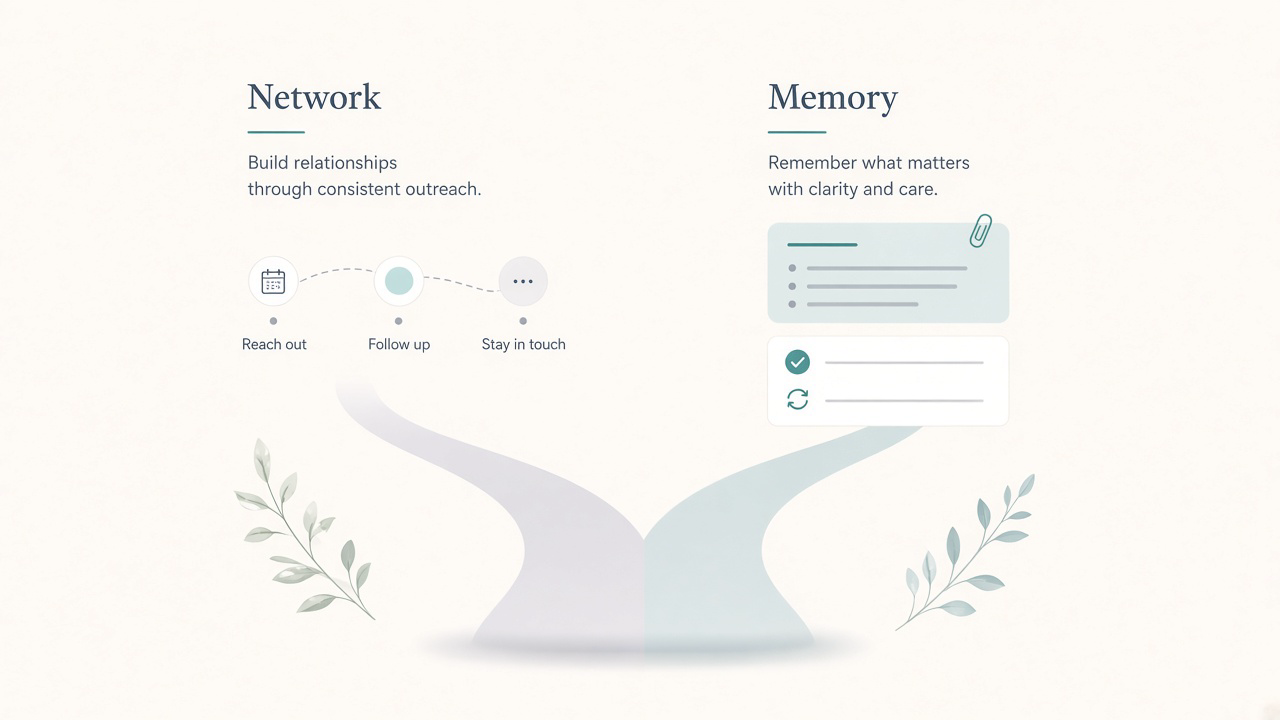
PplBrief is a private personal CRM that remembers what people tell you and tracks the promises you make — in both directions.
That sounds adjacent to tools people call "personal CRMs" — products in the category of Dex, Monica, or folk. Many of them are excellent at organising a network and prompting you to stay in touch. PplBrief is built for a different job: conversation memory and follow-through, not working a contact list on a cadence.
Most personal CRMs organise around the network and prompt outreach on a schedule. PplBrief organises around memory and follow-through: what was said, what was promised, both ways. No scores, no feed, no outreach nudges.
The problem each tool is solving
Three tools get confused because they all touch "people" somehow.
A typical personal CRM keeps a directory of contacts and often reminds you to reach out — weekly, monthly, quarterly — so relationships stay warm. The primary object is the network.
A notes app stores what you wrote. It is excellent at documents and folders. It is weak at filing every conversation against a person and turning spoken commitments into trackable follow-ups.
A task manager stores what you must do. It is excellent at projects and due dates. It usually has no place for what they owe you, and it rarely attaches open loops to a relationship history.
So you end up with contacts in one place, transcripts or scraps in another, and half your promises nowhere. The details that build trust — what someone said under pressure, what you offered to send, what they said they would decide by Friday — quietly slip. That is the gap PplBrief is built for.
Comparison
| PplBrief | Typical personal CRM | Notes app | |
|---|---|---|---|
| Primary object | People + conversations | Contacts / network | Documents and folders |
| Capture style | Quick note after a meeting (type or voice) | Contact fields, timelines, imports | Freeform notes, often not person-first |
| AI role | Extract key points, context, promises, next steps from your note | Varies by product; often assist with drafts, enrichment, or organisation | Summarise documents (if any) — not usually promise tracking |
| Follow-ups | Both ways: what you owe and what they owe, tied to the person | Often reminders to reach out; less emphasis on promises owed to you | Rarely structured; easy to lose |
| Outreach reminders | None by design — no cadence nudges | Common (keep-in-touch schedules) | None |
| Privacy model | Private companion; people don't know they're in it; no feed | Usually private to you; still network-oriented | Private files; weak person graph |
| Best for | 1:1s, clients, conferences, closing the loop on what was said | Maintaining a wide network on a cadence | Long-form writing and reference |
Category behaviour matters more than brand names. Tools like Dex, Monica, and folk sit in the personal-CRM category: they help you organise people you care about and, in many cases, remind you to keep in touch. That is a real job. It is not the same job as walking into Thursday's 1:1 already knowing what was promised last time — including what you are still owed. For why that second half matters, see tracking follow-ups in both directions.
When a personal CRM is the better fit
Use a personal CRM when your main problem is coverage of a network.
You have dozens or hundreds of people you want to stay loosely connected with. You want a single rolodex, birthday or job-change awareness, and a reminder that you have not spoken to someone in three months. You are happy being prompted to send a note just to keep the relationship warm.
In that world, outreach cadence is a feature, not a bug. PplBrief deliberately does not do that. If "work my network" is the weekly ritual you need, a network-first personal CRM is the honest choice.
When PplBrief is the better fit
Choose PplBrief when the job is remembering the conversation and closing the loop.
- Recurring 1:1s with a manager, mentor, or report — where context should compound, not reset
- Clients and colleagues — where last week's agreement is the starting point of this week's call
- Conferences and introductions — capture who they were and what you discussed before the day blurs
- Promises in both directions — what you said you would send, and what they said they would decide
Capture is meant to be fast: speak or type a note in the minutes after a conversation. AI pulls out what matters; you edit. Follow-ups stay attached to the person, not lost in a project board. The product stance stays private and low-key: no scores, no feed, no pressure to "work" contacts.
If that is the job, start with What is PplBrief?.
Is taking notes about people weird?
It can sound calculating. Most people care and forget anyway — conversational detail decays whether or not the attention was sincere. A private note does not manufacture interest you did not have; it stops genuine interest from becoming invisible.
PplBrief is built as a private aid to memory rather than a networking tool. There is no shared profile, no notification to the other person, and no outreach scoreboard. The people you write about do not know they are in it. For the data detail, see the Privacy Policy.
FAQ
- Is PplBrief a personal CRM?
- Yes — in the sense that it is a private tool for people and relationships that belongs to you. No — if "personal CRM" means a network rolodex with keep-in-touch reminders. PplBrief is conversation memory and bidirectional promise tracking. More in What is PplBrief?.
- How is PplBrief different from Dex, Monica, or folk?
- Those products sit in the personal-CRM category and often help you organise a network and stay in touch on a cadence. PplBrief does not send outreach nudges. It focuses on what was said in a conversation and what was promised — including what others owe you. This page describes category behaviour; it does not claim a feature-by-feature inventory of each product.
- Can I use PplBrief together with a personal CRM?
- Yes. Some people keep a network tool for wide reach and use PplBrief for the conversations that need precise memory and follow-through. They solve different jobs.
- Does PplBrief remind me to network?
- No. There are no keep-in-touch schedules or outreach scores. Open follow-ups are about commitments from real conversations, not a cadence to "touch base."
- Do the people I track know they are in PplBrief?
- No. It is a private companion for your preparation and follow-through — no feed, no shared profile, no notification to them.
- Is this for sales pipelines?
- No. Company CRMs are built for pipelines and deals and usually belong to an employer. PplBrief belongs to you and treats a mentor or someone you just met with the same seriousness as a client.
Try PplBrief when the job is the conversation
Try PplBrief when the job is remembering the conversation and closing the loop — not working a contact list.