
Why Your Meeting Notes Don't Help You Next Time
Key takeaways
- Writing it down is not enough — you also need to find it again.
- Notes by date hide people. You need one place per person.
- Promises matter most: what you owe them, and what they owe you.
- Read the person for a minute before the call — not when you tidy Notes on Sunday.
You already take notes. After a 1:1, a client call, or a quick chat at a conference, something lands in Notes or a voice memo.
Then Thursday comes. You are about to talk to that person again. You open the app, scroll, search their name, find a paragraph from three weeks ago — and still walk in cold.
The useful bits are mixed with noise. The promises are not listed. You have about a minute before the call.
So the problem was not that you forgot to write it down. It was that the note never became something you could use.
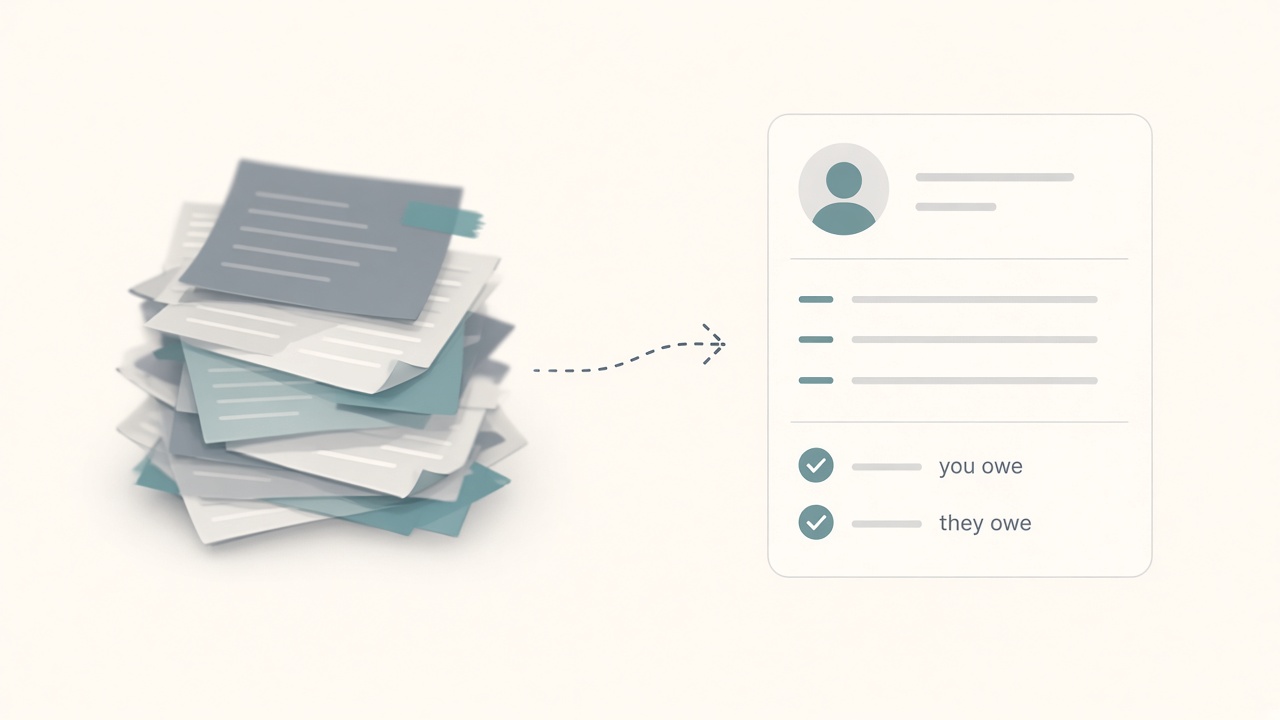
Writing it down is not the finish line
We have written before about why details fade and what to jot after a meeting. This post is about a quieter failure: you did capture it, and it still did not help.
A note sitting in a long date list usually fails three jobs:
- Find the person — not the meeting, not the day.
- Keep what still matters — not every sentence you typed.
- Show what is still open — what you owe them, and what they owe you.
Without those, you re-read a blob under time pressure and guess from memory anyway. That is why “I have notes somewhere” and “I am ready” so often come apart.
Notes by date hide people
Notes apps are great diaries. They are weak at remembering people.
Last Tuesday’s dump might hold three people, two projects, a shopping list, and half a thought about a deck. When you need one person — the mentor you are about to message, or someone you met at an event and promised an intro — you are digging through a timeline, not opening their thread.
You rarely need this on Sunday night while “tidying notes.” You need it thirty seconds before a conversation, when the real question is: where did we leave off, and what is still open between us?
If answering that takes a hunt, the system failed — even if you wrote something down.
For the simple loop — capture, pull out what matters, follow through — see What is PplBrief?.
Promises are the part that hurts when they vanish
Facts about someone are useful. Promises are load-bearing.
“Send me that intro.” “I’ll share the deck.” “Let’s find twenty minutes after the offsite.” Those lines feel light in the corridor. Two weeks later they feel heavy — if neither of you remembers who owed what.
A normal to-do list usually records only what you owe. What they offered lives in your head until it quietly dies. That is why follow-ups feel awkward: you are chasing a fuzzy memory, not a clear item next to a name.
If you want the full take on tracking both sides, read Track Follow-Ups in Both Directions. Short version: if your note does not list promises both ways, it is only half a system.
A simple loop that fits a normal week
You do not need a new personality. You need a habit that fits real life.
1. Capture while it is still warm.
Speak a note on the walk between sessions, or type a few lines after the call. Fresh beats perfect. (At events, that corridor minute does most of the work — more in Remember people you meet at conferences.)
2. Put it with the person, not the day.
One chat should deepen one person record: who they are, what mattered, what you agreed.
3. Keep follow-ups visible both ways.
Yours and theirs. Specific beats vague. A date beats “sometime.”
4. Glance before you talk — not on a big tidy schedule.
One minute on that person before the call turns storage into preparation. A weekly notes clean-up you skip does not.
That loop is not a sales cadence. If “personal CRM” tools feel like outreach machines, fair enough — PplBrief vs a personal CRM spells out the difference: private memory and promises, not pipelines and drips.
What this is not
- Not a reason to scan every badge or blast LinkedIn the next morning.
- Not a shared file the other person can see.
- Not a replacement for listening — just a way to stop real attention from vanishing by Thursday.
People do not need to know they are in your notes. Being reliable is mostly a private systems problem.
Try it on the next chat only
You do not need to migrate five years of Notes.
Pick the next person you will speak to. Capture once. Attach it to them. List what each of you promised. Open that before you talk.
If that feels lighter than scrolling last month’s meetings, you are on the right track.
Want that loop on your iPhone — voice capture, people, follow-ups both ways? PplBrief is on the App Store. Try it on one real conversation and see whether Thursday feels different.
Remember what they said. Do what you said.
Frequently asked questions
- Isn't this just a better notes app?
- Notes apps store what you wrote. For relationships you need the person: context, history, and open follow-ups both ways — ready before you speak.
- Do I need to rewrite every old note?
- No. Start with the next chat. Capture once, attach it to that person, and build from there.
- How is this different from a personal CRM?
- Sales CRMs are for pipelines and outreach. A private companion is for what was said and what was promised — with no shared network and no drip emails.
- What should I open before a call?
- The person, not last month’s meeting list. You want open promises both ways and the last useful context.
- Is there an app that keeps notes by person instead of by date?
- Yes. PplBrief is a private app for iPhone and the web that files every note against the person it came from. Its AI pulls out key points, context and promises, and a follow-ups view splits what you owe others from what they owe you.