
How to Remember People You Only Meet Now and Then
Key takeaways
- Forgetting people you rarely see is how memory works. It is not a flaw in you. The fix is a simple system, not more effort.
- In experiments, people saw having their name remembered as a compliment, and were more willing to say yes.
- People like those who ask follow-up questions. A remembered detail is a follow-up question that waits until the next meeting.
- Light ties, such as acquaintances and old contacts, matter for wellbeing and for work.
- Research on old contacts finds that remembering and catching up are key to picking up a connection again.
You meet some people only now and then. A contact you see at one conference a year. A client's assistant who books your calls. A neighbour you pass on the stairs. A parent you chat to at the school gate.
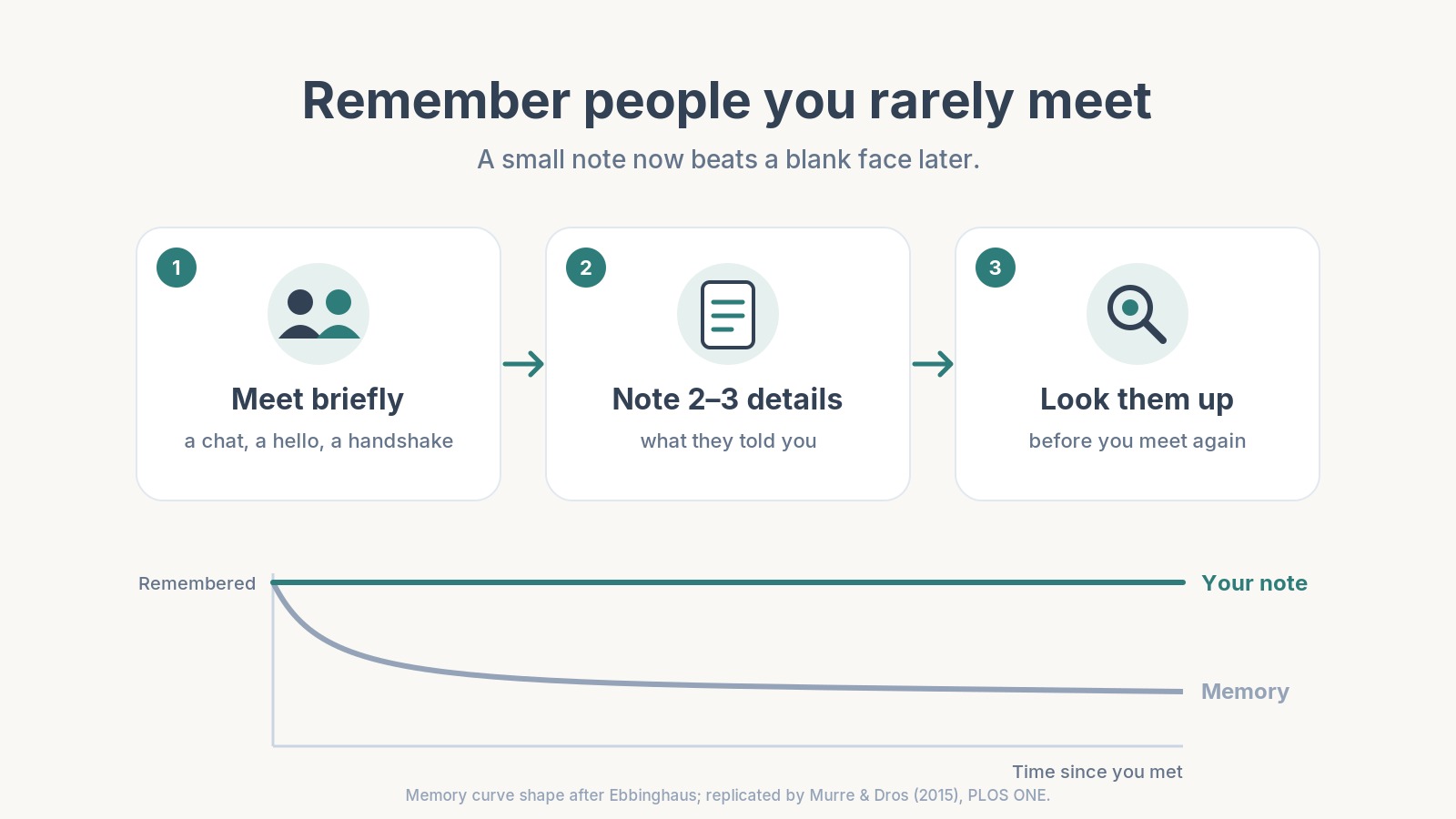
You will not remember every detail about all of them, and you do not need to. A few short notes after you meet, read again before you next meet, are enough. Research on memory, liking and work relationships shows why this small habit is worth it.
Why the details slip away
At the school gate in September, another parent tells you their daughter has just started the violin. You say how nice that is, and you mean it. In January you see them again. You remember the face. You remember that you liked them. The violin is gone.
This is normal. Memory for new information fades over hours and days. The psychologist Hermann Ebbinghaus measured this in the 1880s, and a 2015 replication by Murre and Dros found much the same forgetting curve.
So when you forget what someone told you months ago, it is not a sign that you did not care. It is how memory works. The answer is not to try to hold more in your head. The answer is a simple system that holds it for you.
Being remembered feels like a compliment
You call a client's office twice a year. The same assistant picks up each time. Last time, she said she was about to move house. This time you say her name and ask how the move went. She notices.
Research backs this up. In three experiments by Howard, Gengler and Jain, people whose name was remembered were more willing to agree to a purchase request from the person who remembered it. People saw being remembered as a compliment, and that was what made the difference.
The same study found that forgetting a name did not make people less willing to say yes. That is good news. You do not lose much by forgetting. You gain something real by remembering.
A remembered detail shows you were listening
You meet a supplier at a trade fair. They mention that they are training for their first half marathon. Five months later, before a call, you read your note and ask how the race went.
Researchers at Harvard studied live conversations and speed dates. People who asked more questions, and in particular more follow-up questions, were liked more by the people they talked to. Speed daters who asked more follow-up questions were more likely to get a yes for a second date. The researchers found that follow-up questions made people seem more responsive, which they describe as listening, understanding, validation and care.
A question about the half marathon is a follow-up question too. It just comes a few months later. It tells the other person you heard them the first time.
The same study found something else. People did not expect that asking questions would make others like them more. That may be why this small habit is so easy to skip.
Light ties matter more than they seem
You and your neighbour have never had a long talk. But you know she grows tomatoes on her balcony, and you ask how they did this summer. It takes thirty seconds. You both walk away a little lighter.
Short, friendly contact like this counts. In studies by Sandstrom and Dunn, students felt happier, and felt more that they belonged, on days when they talked to more classmates than usual. When the researchers looked at all daily contact, with close ties and with acquaintances, light ties were also linked to how good people felt.
Light ties matter at work too. A large study in Science used experiments on LinkedIn with over 20 million people over 5 years. It found that weaker ties helped people move to new jobs, but only up to a point. Ties that were weak, but not too weak, helped most.
The people you meet now and then are often exactly these ties. They do not need much from you. They just need you to remember them.
Old contacts are worth picking up again
A year ago, at an industry event, you met someone who had solved the same problem your team now faces. You did not keep in touch. You would like to ask for advice, but writing feels awkward.
Research on "dormant ties", people you used to know but lost touch with, says it is worth trying. When executive MBA students got back in touch with old contacts to ask for advice on a work project, the results compared well with advice from their current contacts.
A follow-up study found that the most valuable old contacts were often people that executives had not spent much time with, but who were trustworthy and willing to help. Yet the executives preferred to contact people they knew well. Getting back in touch can make people feel anxious, so they picked the more comfortable choice.
How you reconnect also matters. A study by Rondi, Levin and De Massis found that reconnecting can fail when people do not refresh the tie. It named three keys to doing it well: remembering, catching up, and seeing the relationship in a similar way.
A short note from last year helps with the first two. You know what you talked about and what you said you would do. Your first message can start from there.
What to write down, and what to leave out
Keep the note small. A few lines are enough:
- Their name, and where and when you met.
- One or two things they told you, such as a new job, a trip, or a child starting school.
- Anything either of you promised, for example "I said I would send the report" or "they will introduce me to their colleague".
Write only what the person chose to share with you, in a way you would be happy for them to see. This is about being a good listener, not about collecting facts. If you want more ideas, see what to write down after every meeting.
Then, before you next meet, read the note again. That takes about a minute.
Where PplBrief fits
PplBrief is a private companion for exactly this. After you meet someone, you type or speak a short note. PplBrief pulls out the key points, the context, any promises, and a suggested next step, and files them under that person.
Before you next meet, you look them up in your people directory and read what they told you last time. Follow-ups work both ways, so you see what you owe them and what they owe you.
Your notes are private by default. The people you write about do not know they are in it. You can read more about this on the privacy page. PplBrief runs on iPhone and on the web.
It is not a sales tool, a network or a feed. If you want to see how it differs, read PplBrief vs a personal CRM, or start with what PplBrief is. For events, see how to remember people you meet at a conference and how to follow up after a conference.
Start with one person
Think of one person you will see again soon but rarely see. Write down the one thing you remember about them, and any promise between you. Next time, read it before you say hello.
If you would like an app to hold these notes for you, you can get PplBrief on the App Store. The free plan covers up to 3 people, which is enough to try it.
Remember what they said. Do what you promised.
Luke Roho is the founder of PplBrief.
Frequently asked questions
- How do I remember people I only meet once or twice a year?
- Do not rely on memory alone. After you meet, write a few lines: their name, where you met, one thing they told you, and anything either of you promised. Before you next meet, read the note again. Two minutes on each side is usually enough.
- What should I write down about someone I just met?
- Keep it short and keep it to what they chose to share with you. Their name, the place you met, one thing they care about, such as a new job, a trip or a child starting school, and any promise in either direction. You do not need more than that.
- Is it strange to keep notes about people?
- Not if the notes are light and respectful. You are writing down what someone told you, so you can ask about it next time. That is what a good listener tries to do anyway. Keep the notes private, and leave out anything the person would not be happy to hear you remember.
- Does remembering small details really help in business?
- Research points that way. In one set of experiments, people saw having their name remembered as a compliment, and were more willing to agree to a purchase request. Studies on old work contacts found that reconnecting with them can be very useful, and that remembering is one of the keys to doing it well.
- Do the people in my PplBrief notes know they are in it?
- No. Your notes are private by default. Nobody is told that you wrote about them, and nothing is shared unless you choose to share it.
Sources
- Replication and Analysis of Ebbinghaus' Forgetting Curve
- What's in a Name? A Complimentary Means of Persuasion
- It doesn't hurt to ask: Question-asking increases liking
- Social Interactions and Well-Being: The Surprising Power of Weak Ties
- A causal test of the strength of weak ties
- Dormant Ties: The Value of Reconnecting
- Reconnection Choices: Selecting the Most Valuable (vs. Most Preferred) Dormant Ties
- The Reconnection Process: Mobilizing the Social Capital of Dormant Ties